Desensitized

Take this post for what it is. There is no existential lesson I , just an observation.

Pretend you live in a beautiful utopia, with cherry blossoms and underrated Cuban sandwhiches. You’ve never seen someone homeless, or even heard of the concept.

One day, you pass a man in tattered clothes, unconscious on the street. What would you do? You’d be shocked. You’d run to them and try to help. Maybe even call 911. You’d ask: What could have possibly happened to this poor person to get in a state like this?

The next day, you see two. What has happened to these people. Is there an epidemic of some sort? What has gotten them in this shape? You would see what could be done to stop this immediately. A trend like this would feel concerning… is there a drug problem? what if it happened to me? It must be raised at our utopian raise it to your Utopian community.

2 years later, and you’re at 100. And what would you say?

“Someone should do something about this.” “I want them out of my neighborhood.”

Wisdom of Crowds

“An intelligent group, especially when confronted with cognition problems, does not ask its members to modify their positions in order to let the group reach a decision everyone can be happy with. Instead, it figures out how to use mechanisms – like market prices, or intelligent voting systems – to aggregate and produce collective judgements that represent not what any one person in a group thinks but rather, in some sense, what they all think. Paradoxically, the best way for a group to be smart is for each person in it to think and act as independently as possible.”

– Wisdom of Crowds, James Surowiecki

Compulsion & Consciousness

“I remember another Jesuit who once said to us at an intimate gathering of the men of our Jesuit province in Bombay, ‘I’m eighty years old; I’ve been a Jesuit for sixty-five years. I have never once missed my hour of meditation – never once.’

Now that could be very admirable, or it could also be a compulsion. No great merit in it if it’s mechanical.

The beauty of an action comes not from its having become a habit but from its sensitivity, consciousness, clarity of perception, and accuracy of response.”

Music

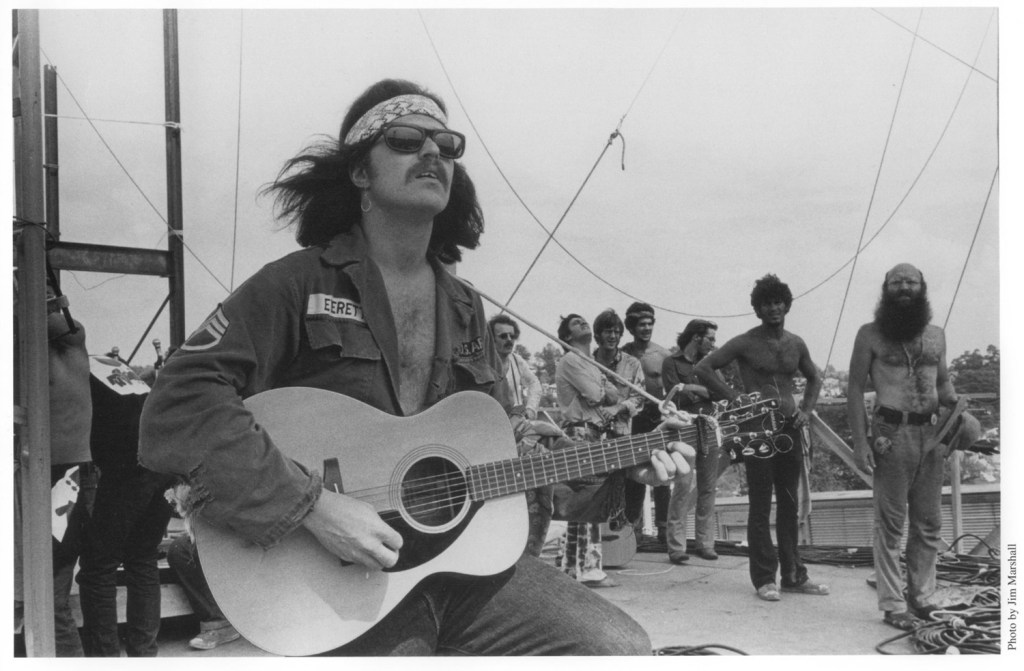
Country Joe McDonald at Woodstock in 1969.

No matter how corrupt, greedy, and heartless our government, our corporations, our media, our religious and charitable institutions may become, the music will still be wonderful.

If I should ever die, God forbid, let this be my epitaph:

THE ONLY PROOF HE NEEDED
FOR THE EXISTENCE OF GOD
WAS MUSIC

Now, during our catastrophically idiotic war in Vietnam, the music kept getting better and better and better.

Kurt Vonnegut, A Man Without A Country

Rewind

Jobs liked to tell the story about how everything that he had done correctly had required a moment when he hit the rewind button.

In each case, he had to rework something that he discovered was not perfect.

He talked about doing it on Toy Story, when the character of Woody had evolved into being a jerk, and on a couple of occasions with the original Macintosh.

“If something isn’t right, you can’t just ignore it and say you’ll fix it later,” he said. ” That’s what other companies do.”

Walter Isaacson, Steve Jobs

Steve Jobs & Sonar

“With the vision came something else, however: an unusual style of interacting with people. Steve was often impatient and curt. When he attended meetings with potential customers, he wouldn’t hesitate to call them out if he sniffed mediocrity or lack of preparation – hardly a helpful tactic when trying to make a deal or develop a loyal client base.

He was young and driven and not yet attuned to his impact on others. In our first years together, he didn’t “get” normal people – meaning people who did not run companies or who lacked personal confidence. His method for taking the measure of a room was saying something definitive and outrageous – “these charts are bullshit!” Or “this deal is crap!” – and watching people react. If you were brave enough to come back at him, he often respected it – poking at you, then registering your response, was his way of deducing what you thought and whether you had the guts to champion it.

Watching him reminded me of a principle of engineering: sending out a sharp impulse – like a dolphins uses echolocation to determine the location of a school of fish – can teach you crucial things about your environment. Steve used aggressive interplay as a kind of biological sonar. It was how he sized up the world.”

Excerpt from Ed Catmull’s Creativity, Inc.